---
title: Guide to Asking Questions in ASK BOSCO® AI Analyst
description: A guide to asking questions in ASK BOSCO® AI Analyst
---
[Skip to content](https://info.askbosco.io/knowledge/general-guide-on-asking-questions-in-ask-bosco-ai-analyst#main-content)
English
Show submenu for translations
[.png?width=260&height=102&name=ASKBOSCO_Logo_Grey_RGB%20(6).png)](https://app.askbosco.io/)
- [Book a call with our team](https://modo25.com/book-a-call/)
Open main navigation
Close main navigation
- [Book a call with our team](https://modo25.com/book-a-call/)
- English
Show submenu for translations
- [Contact us](mailto:team@askbosco.io)
[Contact us](mailto:team@askbosco.io)
How can we help you?
- There are no suggestions because the search field is empty.
1. [Here to Help](https://info.askbosco.io/knowledge?hsLang=en)
2. [ASK BOSCO® Training](https://info.askbosco.io/knowledge/ask-bosco-training?hsLang=en)
3. [ASK BOSCO® AI Analyst](https://info.askbosco.io/knowledge/ask-bosco-training?hsLang=en#ask-bosco-ai-analyst)
# Guide to Asking Questions in ASK BOSCO® AI Analyst
## This article helps you understand the types of questions ASK BOSCO® AI Analyst will answer
[How to frame your questions](https://info.askbosco.io/knowledge/general-guide-on-asking-questions-in-ask-bosco-ai-analyst#how_to_frame_questions)
[Why Questions](https://info.askbosco.io/knowledge/general-guide-on-asking-questions-in-ask-bosco-ai-analyst#Why-questions)
[Mathematical computations](https://info.askbosco.io/knowledge/general-guide-on-asking-questions-in-ask-bosco-ai-analyst#mathematical_computations)
[Grouping](https://info.askbosco.io/knowledge/general-guide-on-asking-questions-in-ask-bosco-ai-analyst#Grouping)
[Filtering](https://info.askbosco.io/knowledge/general-guide-on-asking-questions-in-ask-bosco-ai-analyst#filtering)
[Example questions](https://info.askbosco.io/knowledge/general-guide-on-asking-questions-in-ask-bosco-ai-analyst#Examples)
[Further types of questions](https://info.askbosco.io/knowledge/general-guide-on-asking-questions-in-ask-bosco-ai-analyst#Further)
[Validate ASK BOSCO® AI Analyst results](https://info.askbosco.io/knowledge/general-guide-on-asking-questions-in-ask-bosco-ai-analyst#validate_results)
[Verify with follow up questions](https://info.askbosco.io/knowledge/general-guide-on-asking-questions-in-ask-bosco-ai-analyst#Verify_with_follow_ups)
---
### **How to frame your questions**
**Basic Questions**
One of the approaches for asking questions that will help you get to the expected answer faster is to think of the question in parts.
- What computation do you want ASK BOSCO® AI Analyst to perform? Try to write it in a way that anyone will understand.
- What groupings do you want to see in the final results?
- What filters do you want to apply while generating the answer?

A good question clearly defines all of these aspects in an **unambiguous manner.** Note that since ASK BOSCO® AI Analyst is a conversational experience, you can ask your questions incrementally.
[Back to top](https://info.askbosco.io/knowledge/general-guide-on-asking-questions-in-ask-bosco-ai-analyst#Contents)
---
#### Complex questions
For deeper analytical insights, you can leverage AI Analyst's advanced computational capabilities. This allows you to move beyond simple aggregations and ask questions that require more complex logic. For example:
- Calculate growth (percentage change) of measures over time, such as year-over-year or month-over-month.
- Perform arithmetic operations to derive ratios and percentages, like the percentage of total.
- Analyze product sales to measure performance relative to the total product inventory.
- Embed a query within another query, known as a subquery, to filter based on dynamically computed values (for example, "top 5 product categories").
- Apply conditional logic (if-then-else) to create custom categories or perform what-if analysis.
| Capability | Question | Description |
| --- | --- | --- |
| Growth | Show the growth of sales year over year. | Tracks annual sales growth rates over consecutive years, providing clear visibility into long-term business trajectory. |
| Growth | What is the growth of sales weekly for PPC for the last 8 weeks? | Provides detailed week-over-week growth analysis for PPC across a 2-month window. |
| Ratios/Percentages | What is the percentage share of sales for each product? | Calculates each product’s contribution to overall sales, providing a proportional view of your portfolio performance. |
| Market share | What is the market share of sales for trousers by region. | Calculates the percentage of total sales that comes from trousers for each region. |
| Subqueries | What is the total sales of jackets only from the top 5 cities by sales? | Performs targeted analysis by first identifying your highest-performing cities, then analyzing jacket sales within those markets. |
| Subqueries | Show campaigns that did not have any sales in the last 3 months. | Identifies potentially under-performing campaigns by highlighting those with no recent sales activity. |
| Conditional logic | Show stores that had sales greater than $1000 yesterday and more than $500 today. | Identifies consistently high-performing retail locations by applying multiple time-based sales thresholds. |
| Conditional logic | Show total sales by channel for last month. Highlight channels as top performing… | Calculates total sales per channel, and then categorizes each channel based on its sales using a conditional formula. |
---
### **Why Questions**
ASK BOSCO® AI Analyst can now answer "Why" questions.
How to work with "Why" questions Is explained in this [article](https://info.askbosco.io/knowledge/why-questions-using-ask-bosco-ai-analyst?hsLang=en). Read on for more insights.
[Back to top](https://info.askbosco.io/knowledge/general-guide-on-asking-questions-in-ask-bosco-ai-analyst#Contents)
---
### **Mathematical computations**
ASK BOSCO® AI Analyst can:
- **Count things** in your dataset (for example, *how many campaigns are there?*)
- **Aggregate** metrics (for example, *what is the average sales?*)
- Perform complex **mathematical computations** (for example, How does the ctr for the channel source shopping compare to performance max*?*)
---
### **Grouping**
ASK BOSCO® AI Analyst can:
- Help you **perform the computations for specific groups** (for example, *what is the total sales by channel?* )
- **Create grouping on date columns** on the fly (for example, *what are the yearly sales?* or *what are the monthly sales?*)
---
### **Filtering**
**ASK BOSCO® AI Analyst can:**
- Perform **computations and grouping operations on a filtered set of data** instead of the full table (for example, *what are the total sales for August?* or *what are the sales for this month?* or *what are the sales for SEO in July 2024?)*
---
### Example questions
Below is a quick overview of the kinds of questions you can ask by a combination of above skills. *Note that this is not an exhaustive list.*
**Simple Computations**
| **Sub-category** | **Sample questions** |
| --- | --- |
| Counting | - How many purchases were made last week? - How many clicks were there on Monday last week? - Count the number of campaigns in channel source Performance Max. |
| Aggregation | - What is the average sales for each campaign? - What is the maximum sessions by channel this week? |
| Conditional counting / aggregations | - What is the sales for the channel source shopping last week excluding Wednesday? What would be the sales if channel source Direct were included? |
**Common Date Intents**
| **Sub-category** | **Sample questions** |
| --- | --- |
| Group by date | - What are my weekly sales? - What are the quarterly sales? |
| Filter by date | - What are our yearly sales for the last 2 years? - What are the sales this year? - Show campaigns that did not have any sales in the last 3 months. - Compare the sales of channel SEO for Q1 2025, Q1 2024 & Q1 2023. |
**Advanced Computations**
| **Sub-category** | **Sample questions** |
| --- | --- |
| Ratios and percentage | - What is the percentage of revenue from the Direct channel for the year 2024? - What is the ratio of clicks to impressions? |
| Comparison | - Compare the revenue by device mobile to desktop during march 2024 and march 2025 - Compare sales of PPC and SEO - Compare weekend vs weekday revenue for this quarter. |
| Advanced calculations (change, nested aggregations, conditional logic, etc.) | - What is the change in sales each day this month - What is the month-over-month percentage change in sales for each channel last year? - Can you provide the quarterly revenue breakdown for campaigns that were part of the promotional campaign in Q2? |
**[Back to top](https://info.askbosco.io/knowledge/general-guide-on-asking-questions-in-ask-bosco-ai-analyst#Contents)**
---
### **Further types of questions in ASK BOSCO® AI Analyst?**
ASK BOSCO® AI Analyst will support a few additional types of questions. *Note this is not an exhaustive list.*
**Descriptive questions about selected data source**
| **Sub-category** | **Sample questions** |
| --- | --- |
| Descriptions | - What can I use this data for? - Tell me about this data - What is in this dataset? - I want to decrease operational costs. How can this data help? |
| Explanations | - How is *\[insert formula\]* calculated? - What can I do with time filters? - Show me the steps to calculate *\[insert formula\]* |
**Make recommendations for leveraging selected data source**
| **Sub-category** | **Sample questions** |
| --- | --- |
| Follow-up questions | - What can I analyze next? - What else can I ask about this trend? |
| High-level str | |
---
### **Validate ASK BOSCO® AI Analyst results**
You can verify ASK BOSCO® AI Analyst's results by checking the query and by comparing to the previous step in the conversation.
Let's say you ask ASK BOSCO® AI Analyst, **What are the monthly sales for channel/source Shopping in Google last year?**
The answer is shown:
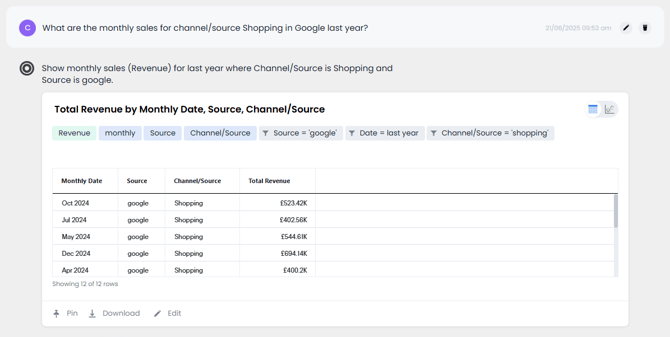
ASK BOSCO® AI Analyst has performed the following actions :
- **Mathematical computation:** The mathematical computations are highlighted in green in the query syntax. In the example above, we can see that the revenue column is marked in green, which shows that we have computed the total revenue.

- **Groupings:** The groupings are highlighted in blue in the search query. In the above example, we can see that monthly grouping is one of the groupings being used. The column label also shows that the Monthly date column is used for this monthly grouping.

- **Filters:** The filters are represented in grey. The query also shows that the system has applied a filter on source=’google’, date=’last year’, and Channel/source=’shopping’.

We recommend that you always check the search data query, as it provides an easy way to validate all the important choices of the column values picked by ASK BOSCO® and how it is using them to build the answer.
[Back to top](https://info.askbosco.io/knowledge/general-guide-on-asking-questions-in-ask-bosco-ai-analyst#Contents)
---
### **Verify the changes after follow-up questions**
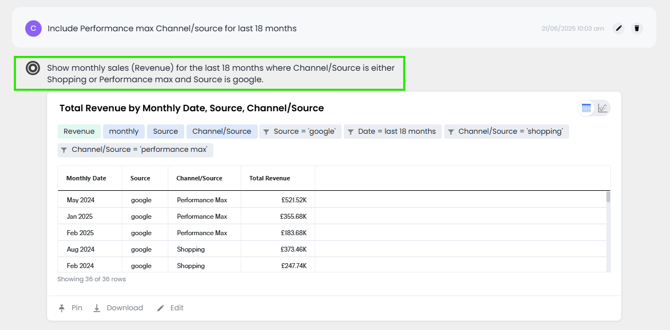
ASK BOSCO® AI Analyst considers each new question in the conversation as a follow-up to the previous question. As your answer becomes more and more complex in the conversation or when you start the ASK BOSCO® AI Analyst experience from a dashboard, you don’t have to continuously validate the query for each answer generated by the system, but you can easily verify.
In the case of follow-up questions, we provide a quick summary before the answer which showcases what has changed from the previous step. For example, if we tell ASK BOSCO® AI Analyst to “include Performance Max for last 18 months” for the question asked in the previous step. ASK BOSCO® AI Analyst shows that it added Channel/Source = 'Performance Max' and changed Date = 'last 18 months'.
---
### Note: Prompt Character Limit
AI Analyst has a **character limit on the prompt input box**.
- The limit is approximately **3,000 characters** (around **500–750 words**)
- This is usually sufficient for most questions and analysis
However, you may reach this limit when:
- Writing very long or complex prompts
- Asking AI Analyst to summarise or recreate an entire conversation in a single query
If this happens, we recommend:
- Breaking your query into **smaller follow-up questions**
- Continuing the analysis step-by-step rather than in one prompt
[Back to top](https://info.askbosco.io/knowledge/general-guide-on-asking-questions-in-ask-bosco-ai-analyst#Contents)
---
This article was updated by Claire. If you have any questions please email [team@askbosco.io](mailto:team@askbosco.io)
March 2026
- [FAQs](https://info.askbosco.io/knowledge/faqs?hsLang=en#main-content)
- [Onboarding](https://info.askbosco.io/knowledge/faqs?hsLang=en#onboarding)
- [Knowledge Hub](https://info.askbosco.io/knowledge/knowledge-hub?hsLang=en#main-content)
- [Getting Started](https://info.askbosco.io/knowledge/knowledge-hub?hsLang=en#getting-started)
- [Data Connections & Integrations](https://info.askbosco.io/knowledge/knowledge-hub?hsLang=en#data-connections-integrations)
- [Onboarding & Implementation](https://info.askbosco.io/knowledge/knowledge-hub?hsLang=en#onboarding-implementation)
- [Using the Reporting Tools](https://info.askbosco.io/knowledge/knowledge-hub?hsLang=en#using-the-reporting-tools)
- [Product Updates & Features](https://info.askbosco.io/knowledge/knowledge-hub?hsLang=en#product-updates-features)
- [ASK BOSCO® Training](https://info.askbosco.io/knowledge/ask-bosco-training?hsLang=en#main-content)
- [Getting Started With ASK BOSCO® Training](https://info.askbosco.io/knowledge/ask-bosco-training?hsLang=en#getting-started-with-ask-bosco-training)
- [Module 1 - Introduction & Overview](https://info.askbosco.io/knowledge/ask-bosco-training?hsLang=en#module-1-introduction-overview)
- [Module 2 - Report Features & Analytics Basics](https://info.askbosco.io/knowledge/ask-bosco-training?hsLang=en#module-2-report-features-analytics-basics)
- [Module 3 - Budget Planning & Allocation](https://info.askbosco.io/knowledge/ask-bosco-training?hsLang=en#module-3-budget-planning-allocation)
- [ASK BOSCO® AI Analyst](https://info.askbosco.io/knowledge/ask-bosco-training?hsLang=en#ask-bosco-ai-analyst)
- [ASK BOSCO® Shopify App](https://info.askbosco.io/knowledge/ask-bosco-shopify-app?hsLang=en#main-content)
- [Getting Started with Shopify](https://info.askbosco.io/knowledge/ask-bosco-shopify-app?hsLang=en#getting-started-with-shopify)
- [Shopify Reporting](https://info.askbosco.io/knowledge/ask-bosco-shopify-app?hsLang=en#shopify-reporting)
- [Product Releases](https://info.askbosco.io/knowledge/product-releases?hsLang=en)
- [Data connections](https://info.askbosco.io/knowledge/data-connections?hsLang=en)
- [Book a call with our team](https://modo25.com/book-a-call/)
[](https://askbosco.io/)
One Embankment, Neville Street. Leeds. LS1 4DW.
Tel: +[44 20 3355 6741](tel:44%2020%203355%206741)
[mailto:email@email.com](mailto:email@email.com)
Copyright © 2025, ASK BOSCO®